Home › Indoor Climbing Wall › Climbing Wall Kids Room
Climbing Wall Kids Room
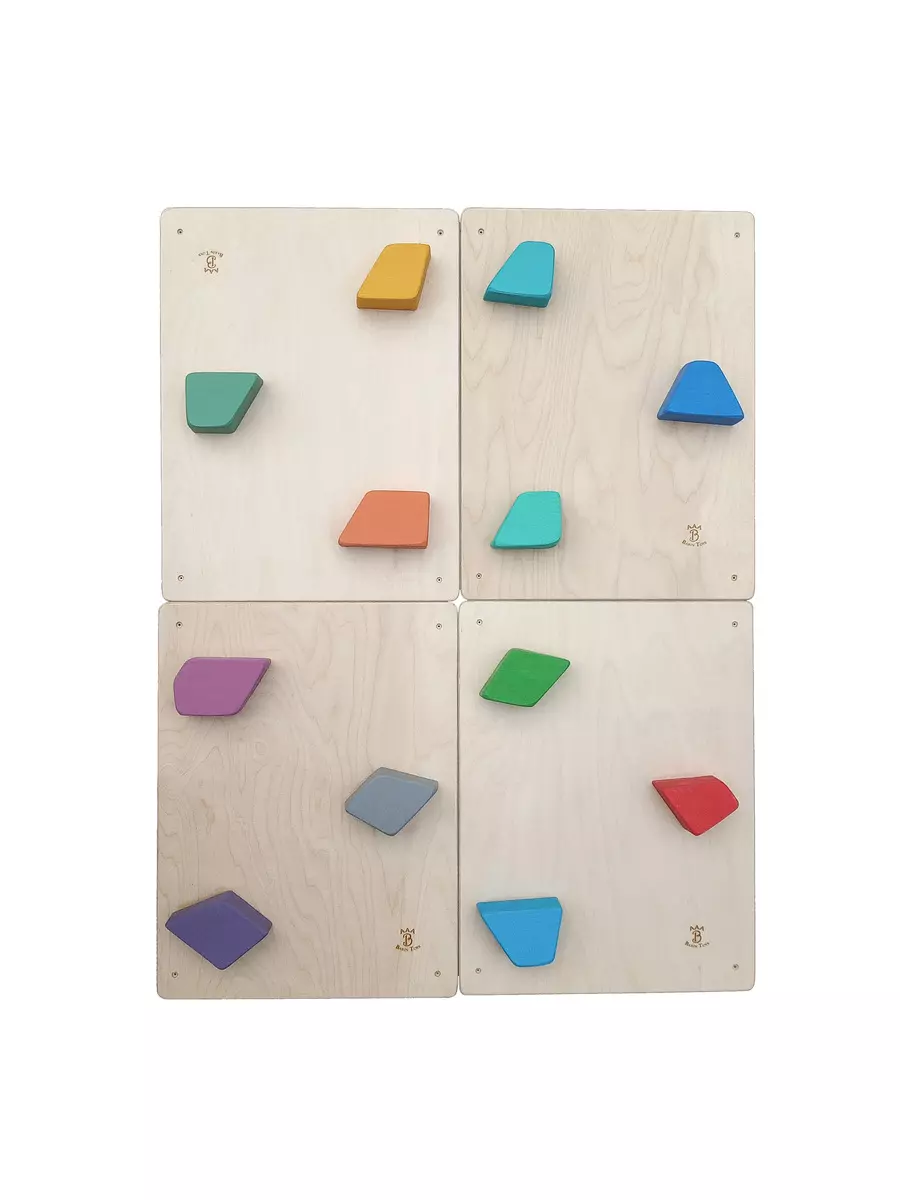
Indoor Climbing Wall for Kids – wooden climbing wall panels and holds
A kids indoor climbing wall from Barin Toys turns an ordinary wall into a permanent climbing station at home — wooden climbing wall panels with holds, ready-to-mount or as a modular DIY system. CE certified, EN 12572 tested to 100 kg. Made from solid Baltic pine in the EU. Free delivery to your door.
A child that climbs, develops. Balance, coordination, strength, and spatial awareness — it happens naturally when the body is allowed to go upward. Equipment that gets used every day and never collects dust.
At a glance
Two solutions — choose what suits your home
Every home is different. We offer a climbing setup that fits — whether you live in a flat or a house with room for a complete wall system.
Perforated panels with coloured wooden climbing holds — classic 3D holds. Each panel comes with 7 holds. Extra sets of 5 available separately — swap colours and difficulty as your child progresses.
Flat panels with cut climbing slots — the natural starting point for a toddler climbing wall. Lower profile, flush with the wall. The slots give a clear, readable grip — the child sees exactly where to place each hand and foot without analysing a 3D hold. As spatial thinking and grip strength develop, the step up to 3D holds becomes the natural next challenge. No age limit — the same panels challenge older children and adults with precision routes.
Wooden climbing holds — why wood and not plastic
Installation — simpler than you think
Safety
What children do on a climbing wall
Climbing wall vs climbing frame — what is the difference?
Looking for a gift for an active child? Our climbing wall panels for kids are the gift that gets used every day — a modular climbing setup that grows with the child and expands as skills develop.
Have a larger project in mind? Our DIY system is designed to be straightforward from start to finish.
Climbing frames for the youngest. Pikler triangle and climbing frame — motor development from 9 months that prepares the child for the climbing wall.
🫐 View baby climbing frameSwedish ladder wall bars for adults. Wall bars for home gym — 200 kg, solid ash.
🏋️ View Swedish ladder wall barsYou are buying directly from Barin Toys' own workshop in Europe — no middlemen, no importers. Every product is always in stock. Orders dispatched next working day. Damage rate in transit under 0.1%. Free delivery on all orders, direct to your door.
Frequently asked questions
Is a climbing wall good for children's motor development?
Yes — climbing is one of the most effective tools for motor development at home. Holds require fine motor skills and strength, route planning requires spatial awareness, and moving up and sideways trains balance and coordination. This happens naturally because the child is motivated by the activity itself.
What is the best indoor climbing wall for kids?
It depends on age and space. For toddlers we recommend our 4-panel starter sets, mounted low with focus on sideways traversing. For older children, the modular DIY system grows with the user.
How many climbing holds do I need?
Each DIY panel comes with 7 wooden climbing holds. Extra sets of 5 are available separately — mount in the pre-drilled holes or on your own surface. All holds fix with 2 bolts M10×60 mm per hold.
How do I build a climbing wall at home?
Mount wooden battens on the wall as guide rails, then fix the panels with wood screws. Already have a wooden surface? Mount holds directly onto any solid board — all fixings come included with the Barin Toys Rocks hold set.
What height is best for small children?
Maximum 1.2 metres for children under 3 years — 2 panels high, in line with EN 12572. Focus on sideways traversing. Always use a gym mat of at least 5 cm and keep 1.5 metres of clear space in front of the wall.
Can a climbing wall be installed in a flat or on a plasterboard wall?
Yes. Wooden battens distribute the load across multiple fixing points — works on plasterboard walls too. One panel 70 cm wide and two panels high already gives a complete climbing experience. Keep at least 1.5 metres of clear space in front.
Can adults use the climbing wall too?
Our climbing modules are tested to 100 kg. For equipment dimensioned for adults — see our Swedish ladder wall bars in solid ash, certified to 200 kg.
How do I maintain a wooden climbing wall?
Solid Baltic pine is low-maintenance. Check that all bolts are tight periodically — especially in the first weeks after installation. The holds are deliberately left without lacquer so they stay slightly textured for grip. If a hold gets dirty or you want to refresh the colour, repaint with acrylic paint — no sanding needed. We also offer holds in untreated pine or ash for a pure tactile feel.